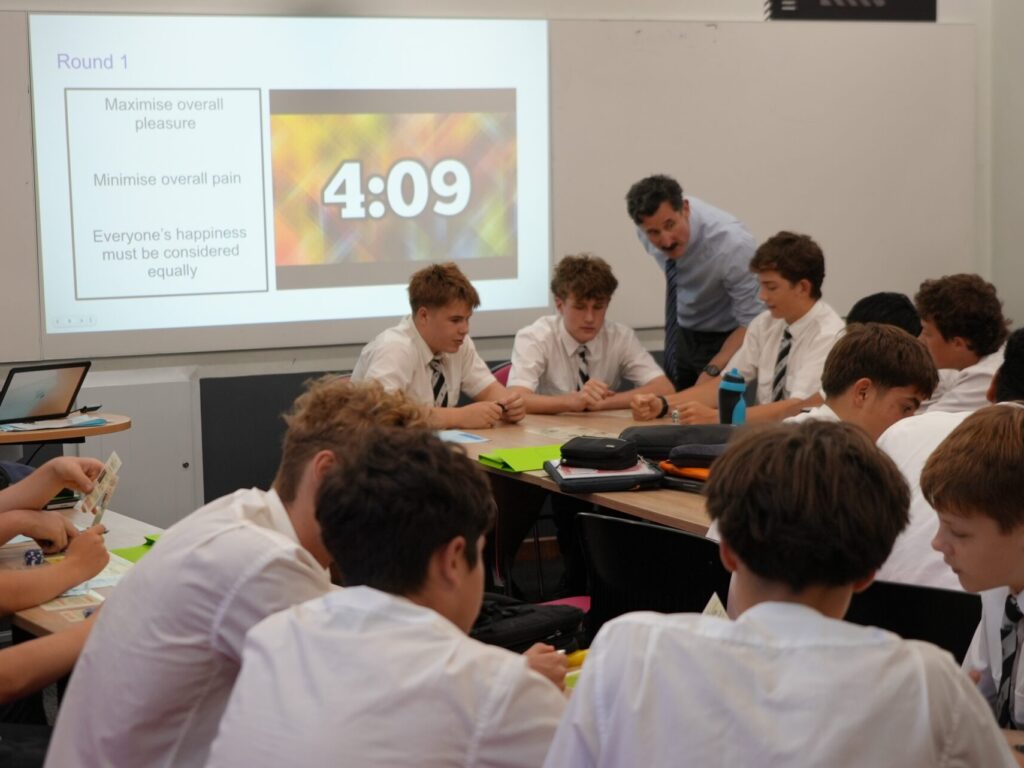
Ethics Olympiad finalists argue the good fight
Does watching a bullfight match make spectators guilty of animal abuse? In war, is providing intelligence as a civilian, ethical? Is it morally wrong to commit acts of cruelty against friendly video game characters who don’t actually exist?
These were the sort of curly moral and ethical dilemmas our Newington Ethics Olympiad Intermediate team contended, avowed and contested in the Ethics Olympiad International Final this week.
Meeting online with finalists from 50 other schools around the globe including Australia, NZ, Hong Kong, India and Canada, Newington’s Year 10 advocates, Sachin H, Marcus T and Henry V argued with the best of them.

Says Mr Andrew Costantino, Head of Philosophy and Religious Studies, and coordinator of Newington’s involvement in the Ethics Olympiad, the students trained hard to get to the final and brought ‘passion and genuine interest to each training session.’
‘Out of 50 teams, the Newington team finished sixth, a great achievement. The team was also the second best performer across NSW schools and the third best in Australia.’
Harvard, Westlake, USA ultimately took home the gold medal.
The Ethics Olympiad differs from a debate as students are not assigned opposing views; rather, they defend whatever position they believe is morally right.
‘Team members are required to consider alternate points of view, and the team does not have to reach consensus; different views can exist within the same team, and they often do,’ explains Mr Constantino.
‘The emphasis is on clear and critical reasoning expressed through respectful philosophical dialogue.’
Points are accumulated over rounds, and teams succeed by demonstrating they have thought critically, acutely and perceptively about the moral dilemmas posed. Points are also awarded for the quality of a team’s dialogue and respectful engagement. Initially, teams compete against other schools in their own regional or state heats, and then the top two competitors from each of these heats qualify for the final round – the International Ethics Olympiad.
Now in its eighth year, the Ethics Olympiad is a competitive but collaborative event in which teams from 400 schools across the world analyse and discuss real-life, current, ethical issues facing society – so making the final is a significant achievement.
Team member Henry V says the benefits of being involved are mulitfaceted.
‘It strengthens your critical thinking, improves your discussion and listening skills and builds your confidence in speaking. Most importantly, it encourages open-mindedness and empathy, because ethical questions rarely have one single answer, so you learn to understand why different people may think differently,’ he says.
‘I was initially drawn to sign up because it felt different from most competitions. Instead of memorising information, it focuses on real-world questions about how people should act, which makes it more engaging and meaningful.’
Mr Costantino concurs, adding the Ethics Olympiad is a fantastic opportunity for students to build on their philosophical studies and extend their capacity for critical thinking and reasoning.
‘The competition provides a valuable opportunity to expose students to these kinds of big questions. It strengthens the subject, strengthens the quality of the dialogue and extends on what the students are already doing in their Critical Thinking and Philosophy classes.’
Newington also fields a senior Olympiad teams with the Senior Olympiad Final to take place in May.
To learn more about Newington’s Critical Thinking and Ethics Centre click here, or to find out how to engage in critical thinking and philosophy in the classroom in one of our 2026 Philosophical Community of Inquiry Workshops, by clicking here.